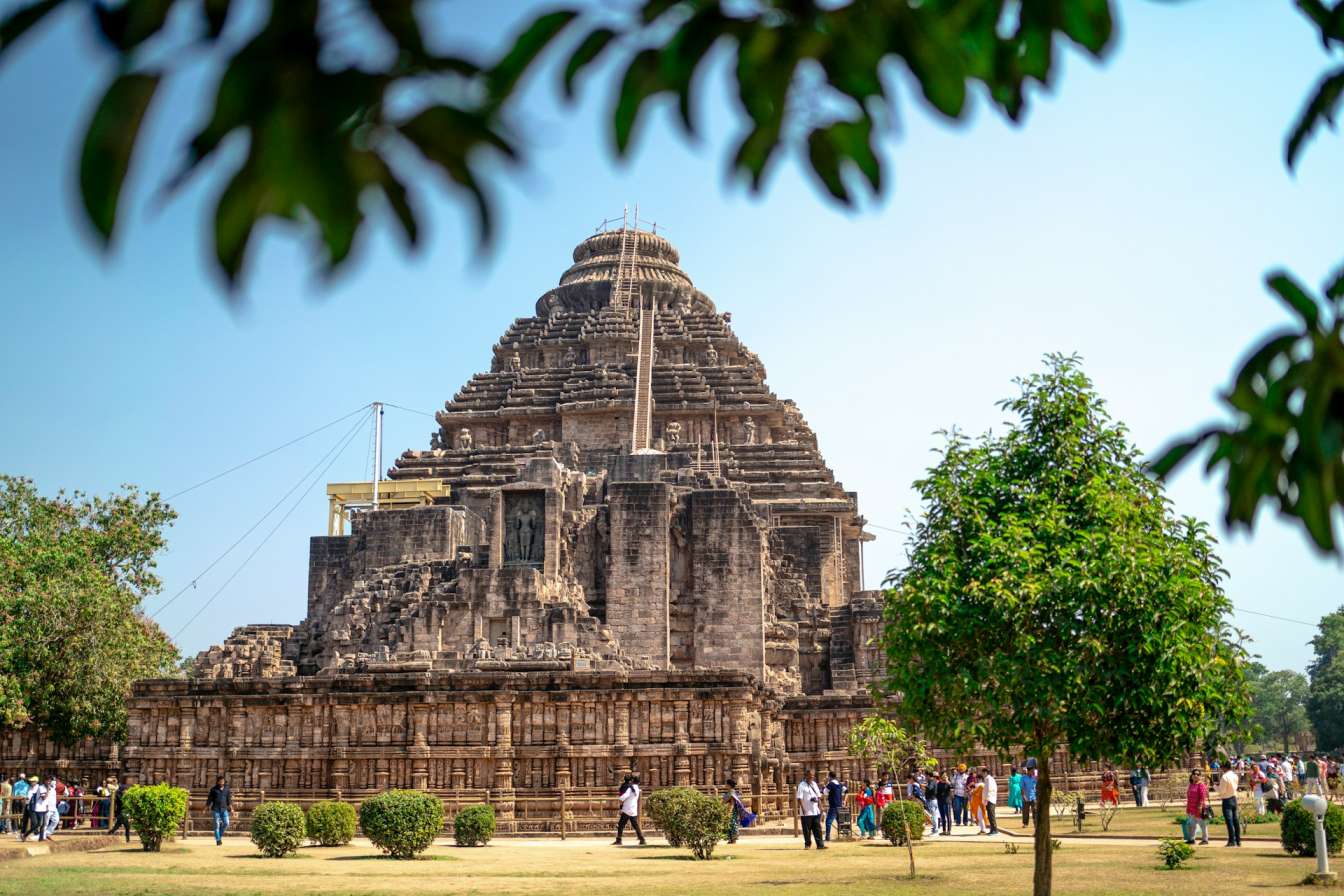
The Konark Sun Temple
Quick Facts
- Opening Hours:
- Generally open from 6:00 AM to 8:00 PM (sunrise to sunset).
- Official Website:
- https://asi.payumoney.com/
About This Place
The Konark Sun Temple, a monumental 13th-century edifice in Odisha, stands as a crowning achievement of Kalinga architecture and a testament to the advanced artistic and scientific understanding of ancient India. Commissioned by King Narasimhadeva I of the Eastern Ganga Dynasty around 1250 CE, this UNESCO World Heritage Site is uniquely conceived as a colossal chariot of the Sun God, Surya, symbolically drawn by seven galloping horses and resting on 12 pairs of intricately carved stone wheels. Each of these massive wheels, nearly 10 feet in diameter, functions as a precise sundial, capable of telling the time of day with remarkable accuracy, reflecting the profound astronomical knowledge of its builders. While the main sanctuary’s towering shikhara (spire), once over 200 feet high, has largely collapsed, the surviving Jagamohana (assembly hall) and the Natamandira (dance hall) continue to mesmerize visitors with their unparalleled sculptural wealth. The temple’s surfaces are a veritable canvas of life, adorned with thousands of figures depicting deities, musicians, dancers, warriors, courtly scenes, and a captivating array of flora, fauna, and mythological creatures, all rendered with an astonishing level of detail and vitality. Beyond its religious significance, the Konark Sun Temple serves as an invaluable historical document, offering a vivid glimpse into the social, cultural, and political life of the Kalinga kingdom during its zenith. Its architectural grandeur, symbolic depth, and artistic sophistication collectively establish it as one of the most magnificent and enigmatic monuments of human civilization.
Things to Do Here
- Admire the Architectural Grandeur:
- The temple is designed as a colossal chariot of the Sun God, Surya, with 24 intricately carved stone wheels (each almost 10 feet in diameter) and pulled by seven mighty horses.
- Spend time observing these wheels – they are not just decorative but also function as precise sundials, capable of telling time accurately. Try to understand how they work with the help of a guide.
- Marvel at the sheer scale of the structure, even in its ruined state. The surviving Jagamohana (assembly hall) is still impressive.
- Explore the Exquisite Sculptures:
- Every inch of the temple is adorned with thousands of detailed carvings. These depict a vast array of subjects:
- Deities and Celestial Beings: Figures of gods, goddesses, apsaras (celestial nymphs), and musicians.
- Scenes of Daily Life: Depictions of kings, warriors, courtly life, hunting, and various human activities.
- Animals and Mythical Creatures: Lions, elephants (nearly 2,000 marching around the base), horses, and a variety of mythological beasts.
- Erotic Sculptures: Located primarily on the second level of the jagamohana (porch), these are famous for their artistic execution and representational quality.
- Floral and Geometric Patterns: Intricate decorative designs fill every available space.
- Visit the Remaining Structures:
- While the main shikhara (spire) has collapsed, explore the well-preserved Jagamohana (audience hall) and the open-air Natamandira (dance hall), known for its exquisitely carved pillars depicting dancers and musicians.
- Look for the colossal statues of war elephants and war horses at the side of the main temple.
- Explore the two smaller temples within the complex: the Mayadevi Temple (believed to be older than the main temple and possibly dedicated to Surya's wife) and the Vaishnava Temple.
- Visit the ASI Museum (Archaeological Survey of India Museum):
- Located near the temple, this museum houses many of the fallen sculptures and architectural fragments excavated from the Konark complex. It's an excellent place to see close-up details of the carvings and understand the temple's original grandeur.
- Attend the Sound and Light Show:
- Every evening (except during heavy rain), a captivating sound and light show narrates the history and religious significance of the Konark Sun Temple. This is highly recommended for a deeper understanding. Check timings locally (usually starts around 6:30 PM or 7:30 PM depending on the season).
- Visit Chandrabhaga Beach:
- Located just 3 km from the temple, Chandrabhaga Beach is a serene and beautiful beach, historically significant for the annual Chandrabhaga Mela (fair) dedicated to the Sun God. It's a great spot to relax after exploring the temple and catch a beautiful sunrise or sunset.
Photo Gallery